Posts

Sillustani, Peru June 13, 1979

Image
We went back to Puno for a day before heading to Bolivia.     Hit the market and bought too many things that I’ll now have to carry… .      And went to see the nearby Sillustani ruins.     These were very dramatically located on the top of a hill overlooking a beautiful and very still Lake Amayo, with a truncated volcano island in it.     And a backdrop, on all sides, of distant, yet distanceless, mountains.     It felt like a very powerful place.      The ruins themselves were a series of stone ‘silos’, which served as funerary towers, and urns.  They were both rounded and rectangular, some as high as 12 metres.  Some were made in the stone-cut-and-carefully-fit-together Incan style, but most were built in the more rustic cobblestone wall style, glued together, once upon a time, with mud adobe.  Apparently some had at one time been faced with white-painted adobe, but most of this has wea...

Map of Bolivia

Image
  The above map gives the best impression of just how mountainous the western side of Bolivia is. This is where I spent all of my time - La Paz, Cochabamba, Sucre and Tarabuco (near Sucre). The below map is a little easier to read.

Copacabana, Bolivia June 14, 1979

Image
One incredible day… .     The bus that Sue and I should have gotten from Puno to Yunguyo never arrived, so finally at 9:30 they decided to enlist the service of another empresa (bus company).     Unfortunately that company’s buses are about half the size, and in less than half as good condition.     Boarding took over half an hour – arguments, counter-arguments, who would get on, who wouldn’t; people climbing over bags and other people to reach ‘their seats’ (have to use the term loosely, as no seats are assigned, and many seats are in a such a poor state of repair that they could hardly be called seats).     I was lucky and got a seat up front, on the right hand side, just behind the flip-back driver’s assistant’s seat, on which were perched two very heavy Swiss guys and the driver’s assistant.    Sue ended up somewhere in the back... The bumpy ride over a rough, pot-holed, dusty road in a bus with no shocks left me with two very bruise...

La Paz, Bolivia June 15-18, 1979

Image
Of course the bus didn’t leave Copacabana at 6, as scheduled – no surprise there – but we were on our way by 8, which was better than we might have hoped for.     The ride to La Paz took us through a beautiful but bleak landscape – more altiplano grass lands, highlighted by lake and distant, but ever-approaching mountain peaks topped with dazzlingly white snow.     La Paz is a big city, by south American standards, about the size of Vancouver.     It’s fairly modern, and appears quite wealthy, especially in comparison with the cities in Peru.     But it feels quite a lot like a Guatemala City kind of place – nothing much to recommend it, a disappointing dearth of places to eat (like Guat City).     The food is also disappointing; nowhere near as good as in Peru.    But the artesania items on sale – alpaca, mantas, silver and leather – look good; better quality than in Peru, although at somewhat higher prices. Unfortunately I am...

Sucre, Bolivia June 19-23, 1979

Image
We took a German-made ferrobus from La Paz to Sucre – all plastic and chrome, slick and clean, smooth, fairly quiet, with great service.     But… it was not really the right kind of transport for the kind of service they were running.     It was more like a commuter train – narrow bench seats with no leg-room, even for a shorty like me, very hard and straight seat-backs that ended at the shoulder, so no way to rest your travel-weary head.     Add to that the discomfort of a heating system on overdrive, and folkloric music being played beyond distortion levels, the same tape, over and over, until well after midnight.     There was no way to get comfortable (and I tried every position known to long-distance travellers).     Finally, in desperation, I got up and went to the front of the car, where the bathroom was, and lay down on the floor in front of the door to the next car, where at least it was cooler.    Still, I passed a to...

Tarabuco, Bolivia June 23-24, 1979

Image
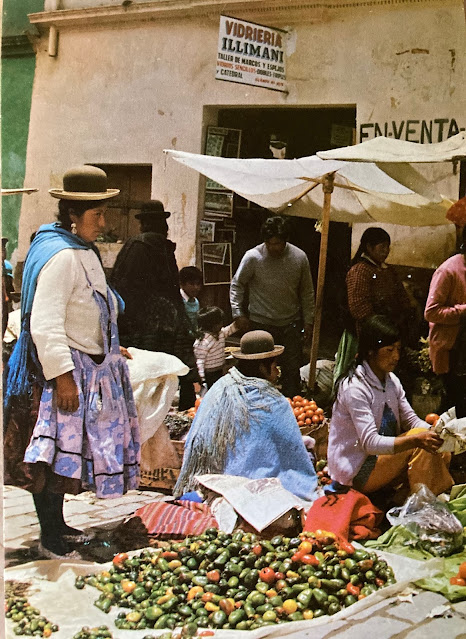
Tarabuco is a small town not far from Sucre, known primarily for it’s colourful people, still mostly wearing traditional clothes, and it’s weekly market.     We caught an early morning ride in a big fast camionetta over a gravel, but smooth and well-graded road, through an altiplano landscape of dry mud-brown plains and rolling hills.     It wasn’t as flat as I had expected, but much drier.     So very parched, you can almost smell the dryness.     Strawlike stubble growth (apparently alfalfa) in some fields; the withered stumps of potato plants in others.     Dirty cream-coloured sheep and small hers of llamas, looking for something to eat, rooting around in the dusty earth like pigs.     Houses scattered about but well camouflaged, made of the same mud-coloured adobe as the surrounding landscape, thatched with dun-coloured grasses, and encircled by low stone walls.     Set slightly apart from each adobe house is an ...

Cochabamba, Bolivia June 30 – July 2, 1979

Image
We spent a couple of nights in Sucre trying to organize transportation to Cochabamba.     This was more difficult than we had anticipated because of the election on July 1 st .     Because Bolivians must vote, according to Bolivian law, in whatever place they are registered to vote (usually where they live, but often not where they work), many of them were travelling by bus, train, truck and even plane to get where they needed to be.     This will be the first general election in 12 years (or more), and excitement and anticipation was high.     Most of the buses travelled at night, which is not our preference, but there wasn’t much choice.    It was not a comfortable ride.   We arrived in Cochabamba the day before the election.  The next morning we awoke to find that everything was closed: shops, restaurants, even large markets.  So it was difficult finding something to eat.  Fortunately a few vendadora...